I’m Dr. Rima Vesely-Flad — a scholar, the author of three books, the Founding Director of the Initiative for Black Buddhist Studies, and a Research Fellow at the Institute of Buddhist Studies.
That’s the short version.
It doesn’t say much about how I actually got here, or why this particular work, so let me back up.
How this work took shape
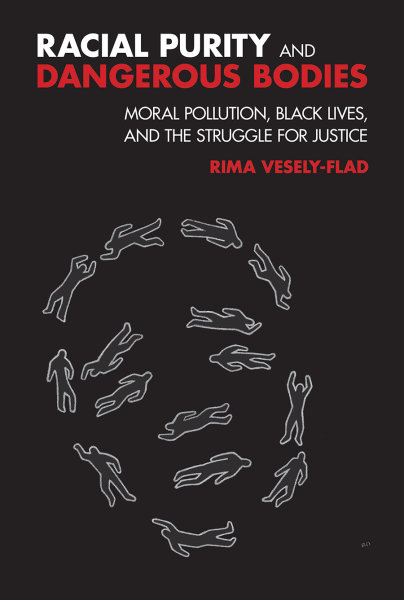
I started out asking questions about suffering, purity, and the body — specifically, how ideas about moral “pollution” get mapped onto Black bodies, and what that costs people in the real world. That line of inquiry became my first book, Racial Purity and Dangerous Bodies: Moral Pollution, Black Lives, and the Struggle for Justice (Fortress Press, 2017).
Around that same period, I was teaching college-level courses inside Sing Sing Prison. Teaching inside the prison, in particular, changed how I thought about liberation. It stopped being an abstraction and became something I watched people practice, in real time, week after week. This experience took me back to graduate school for a doctorate in Social Ethics. My time at Union also introduced me to a rigorous tradition of Black liberation theology, and I began to notice how much that lineage had in common with the Buddhist teaching I’d been quietly practicing for years. I later taught undergraduate seminars at Sarah Lawrence College and Warren Wilson College, and graduate seminars at Union Theological Seminary.
I’ve also spent a significant part of my adult life outside the United States. I’ve been awarded two Department of State Fulbright Scholarships — the first as a graduate student in South Africa, the second as a faculty member in Ghana — and I lived for a period in Venezuela as well. Since then I’ve traveled to more than twenty-five countries, Palestine most recently. Living inside a place, rather than passing through it, changes how you read everything that comes after: your own field, your own training, your own assumptions about whose knowledge counts as knowledge.

Those years abroad, combined with the seminary teaching, pushed me toward a bigger question: what happens when the lineage of Black liberation theology is brought into direct conversation with Buddhist practice — not Buddhism as filtered through the dominant, largely white American mindfulness industry, but Buddhism read through Black radical thought and the Black literary tradition?
That question became my second book, Black Buddhists and the Black Radical Tradition: The Practice of Stillness in the Movement for Liberation (NYU Press, 2022), which examines how Black-identifying Buddhist practitioners interpret the dharma in ways that are deeply congruent with the Black radical tradition.
I currently hold a faculty position as Research Fellow at the Institute of Buddhist Studies. My work has also been supported, at various points, by grants from the Fetzer Institute, the Henry J. Luce Foundation, the Frederick Lenz Foundation, and the Crossroads Program.
What I’m actually working toward
Underneath the titles and the publications, here is the clearest way that I can describe what I’m working toward:
I am working to build a world in which we feel safe, and our nervous systems can relax.
A world in which people of all different backgrounds are honored in our differences and celebrated for our gifts.
A world in which we can grow together and be messy together and be held accountable without rupturing relationships.
A world in which we support one another, help raise one another’s children, and feed one another outside of transactional expectations.
A world in which violent forces are held accountable, and exploitation — personal, communal, environmental — is named, addressed, and repaired.
Everything I’ve written and taught is, in one way or another, in service of that vision. My audience is deliberately broad: I write for popular and academic readers alike, and I try to speak as directly to scholars and practitioners of Buddhism as I do to activists, and especially to activists of African descent, who may have never disconnected their politics and their spiritual lives.
How I approach the work
A few commitments guide how I teach and write, regardless of the format. I care about people’s mental and physical health, not as an abstract wellness principle but as a precondition for the kind of thinking and organizing I hope this work supports. I try to honor the intellectual and spiritual labor of the scholars and practitioners who came before me, and to build ideas that feel culturally resonant to Black activists and practitioners rather than translated for them after the fact. I also see mentoring as part of the work itself, not separate from it.
What I bring to this, if I’m honest about my own strengths, is a habit of identifying patterns across disciplines that don’t usually speak to each other — literary criticism, Buddhist philosophy, Black radical theory, liberation theology, feminist thought — and a long-standing contemplative practice of my own that keeps that thinking grounded rather than purely academic. I share the results primarily through writing, through teaching, and increasingly through public speaking and podcasting, because I think this work needs more than one format to actually reach the people it’s for.
The most recent book, and where it came from
As I interviewed Black Buddhist teachers and wrote a book on their innovative practices, I noticed that many uplifted James Baldwin and Audre Lorde as luminaries through whom the teachings shone brightly.
Their witness led me to do a deep dive into the essays and interviews of Baldwin and Lorde – and to consider how Baldwin and Lorde used their lives to illuminate eternal truths about the human condition and the delusion embedded in white supremacy.
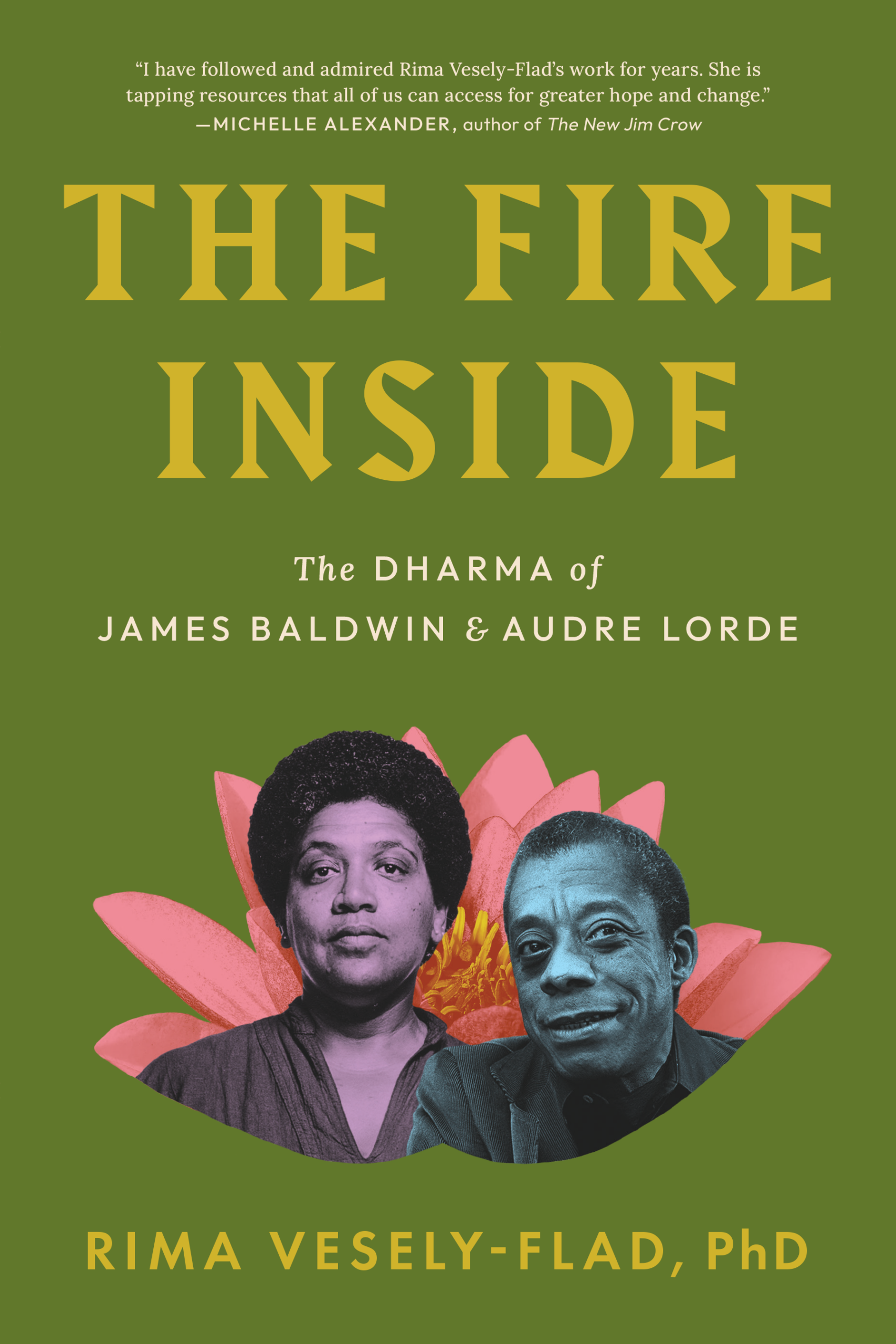
The Fire Inside: The Dharma of James Baldwin and Audre Lorde (North Atlantic Books, 2026) elevates Baldwin and Lorde — two Black, queer writers who never called themselves Buddhist — as ancestors of an embodied dharma: teachers of resilience, fortitude, presence, and joy, writing from inside a racist, patriarchal, homophobic context that was actively trying to break them.
It’s the book that, more than the other two, sits closest to how I actually live and teach day to day.
It’s a practice-oriented book that draws upon Baldwin, Lorde, Buddhist teachings across centuries, and rituals offered by contemporary Black Buddhist teachers, including Lama Rod Owens and Ruth King.
The Initiative for Black Buddhist Studies

The Initiative for Black Buddhist Studies is where this body of work now lives.
I founded it because I wanted to communicate contemplative practices rooted in the Buddhist tradition in ways that are culturally and politically resonant for people who have been failed by institutions they were supposed to be able to trust — and because I wanted a space that didn’t ask anyone to leave their history, their politics, or their body at the door.
It’s a home for spiritual seekers and contemplatives, Buddhist practitioners, lovers of Black and queer literature, activists, and writers.
The courses take the form of four six-week modules.
The first, a self-guided class meant for sanghas and institutions, takes up the dharma of James Baldwin and Audre Lorde directly.
The other three courses are offered live with my co-teacher Rashid Hughes.
One examines the relationship between Buddhism and Black liberation more broadly.
Yet another draws on the work of Black feminist scholar and Buddhist practitioner bell hooks, and her insistence that spiritual practice and feminist discipline are inseparable.
Finally, another course looks at the forms of power already available to us in community, and how conflict and harm tend to dilute it.
Pricing is offered on a sliding scale, because I don’t believe the people who most need this work should be priced out of it.
Buddhism and Black Liberation | Oct. 11, 2026 — Nov. 15, 2026
The Discipline of Liberation | Jan. 3, 2027 — Feb. 7, 2027
From Poison to Power | Feb. 14, 2027 — Mar. 21, 2027
Outside of the work
I’m the parent of two children, ages sixteen and ten, and the foster parent of a teenager. Over the past decade, my spouse and I have fostered more than ten children. Fostering has taught me more about impermanence, attachment, and what it actually means to show up for someone than any text I’ve studied — and I’ve studied a great many texts. It has also kept me honest about the distance between the world I write about and the world I actually live in day to day, with school pickups and paperwork and everything else that comes with raising children who are not always your own by birth.
Some of my favorite activities are hiking, biking, and swimming in the Blue Ridge Mountains of Western North Carolina. I am often working out ideas while I do these activities. I read constantly – poetry and social theory most of all – and I try to get to a meditation retreat when I can carve out the time. None of this is separate from the scholarship. It’s the ground the scholarship stands on.
In their own words
Rather than describe what it’s like to study with me, I’ll let a few former students say it themselves.
“Dr. Rima has a way of using the technology to actually build trust, intimacy, and healing community over time,” Jae Carey wrote after a fully virtual course. “I found myself opting for camera-on, participating wholeheartedly, and being touched and changed not only by her teaching and embodiment, but by the group dynamics and deep sharing.”
Ollie Gillett described it this way: “Dr. Rima brings a depth of intentionality, presence, and attuned listening to every room she’s in that’s hard to describe unless you’ve experienced it firsthand… what I was most struck by was how it felt to be seen, heard, and reflected back by somebody with such deep practice and generosity of spirit.”
And Steff Reed, a former student at Union Theological Seminary, put it simply: “Dr. Rima is a thoughtful, loving and heart centered educator. She authentically embodies intellectual rigor and spiritual care at the highest level. In every class, Dr. Rima seamlessly impacts every register: heart, mind, body and soul.”
Get in touch
If this work speaks to you, take a look at the current courses, or reach out directly.
I’m glad you’re here.
Affiliations