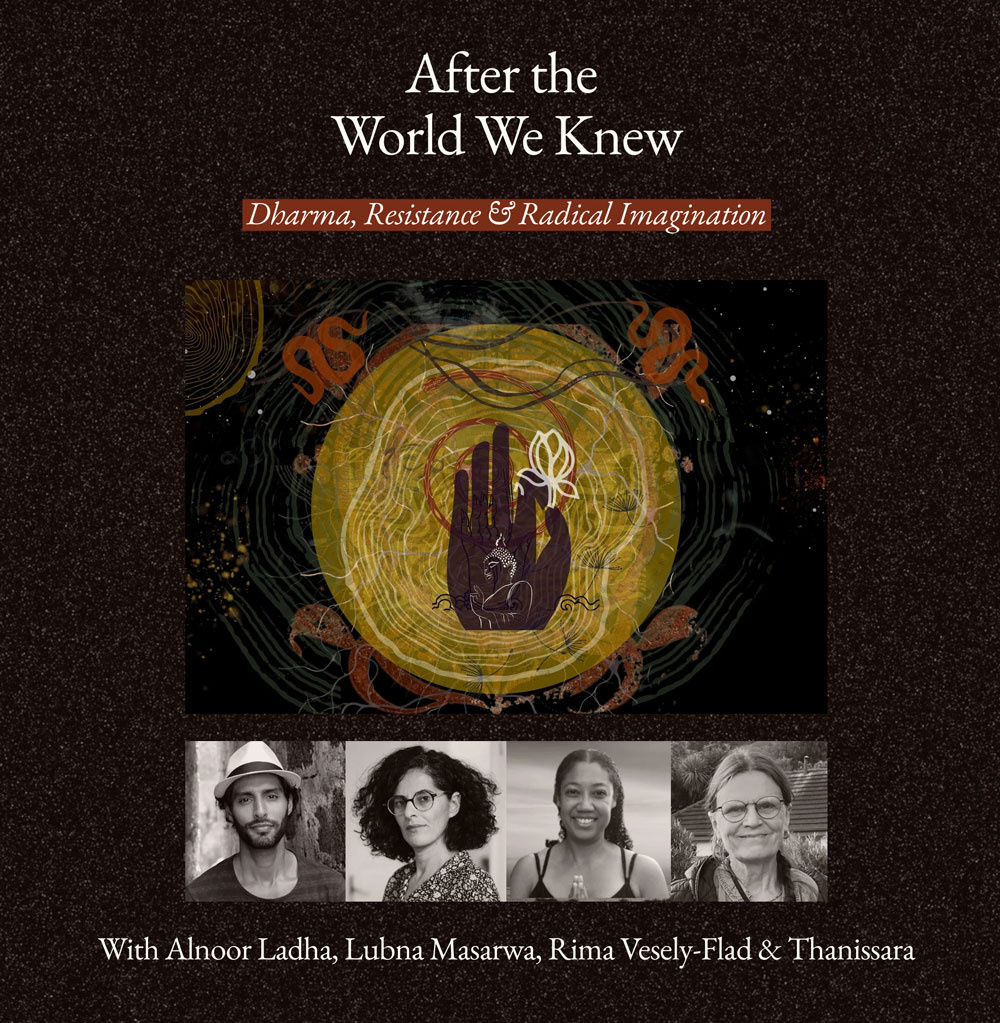
After the World We Knew – Dharma, Resistance & Radical Imagination

November 16, 2026 | Events, Featured

Presented by Sacred Mountain Sangha 🗓️ Dec 6, 2026 @ 9:00 AM – 11:00 AM PT 📍Online via Zoom  

Over the last three years, the world has shifted beneath our feet.

The genocide in Gaza has ruptured assumptions about international law, human rights, political institutions, and the moral credibility of the West. Climate breakdown is accelerating as we cross increasingly dangerous thresholds. Authoritarianism and fascistic movements are gaining ground. Artificial intelligence is transforming societies at extraordinary speed as it transmutes from “save all” to “terrifying threat,” while wealth and power is now concentrated into the hands of a few who cannot be trusted.

So where to now?

Sacred Mountain Sangha invites you to an end-of-year gathering and benefit: a conversation among spiritual teachers, activists, thinkers, and movement builders reflecting on what these last years have revealed, and what they now ask of us. Rather than asking how Dharma and spirituality can help us adjust to an increasingly untenable world, we want to ask a more radical question: How might spiritual wisdom help us move beyond business as usual altogether?

More from Dr. Rima Vesely-Flad

James Baldwin argued that racism is not a “Black problem” but a white fear-driven delusion that scapegoats Black people and evades interior work. Drawing on Baldwin’s essays and testimony, we discuss his critique of white moral pretentiousness, evasion, and the projection of shame and fear—especially the fear of death—onto Black bodies. We also see how Baldwin’s analysis relates to Buddhist teaching on dependent origination from the Rice Seedling Sutra.
In this dharma talk, we investigate the role of Sati—which is translated as knowing, awareness, presence, or mindfulness—in the writings of James Baldwin and Audre Lorde, in conversation with early Buddhist writings.
In this dharma talk, we understand the weight of suffering through the eyes of James Baldwin and Audre Lorde. We learn how Baldwin gleaned the difference between suffering due to the violence of racism, and suffering that is central to the human experience. We learn about Lorde’s embrace of the idea that pain can teach us something important, but that we need not suffer uselessly.

Want to stay connected? Subscribe to my Substack, Training Anger with Accuracy.