
Presented with the Institute of Buddhist Studies
🗓️ February 3, 2027 @ 4:00pm PST / 7:00pm EST
📍Online
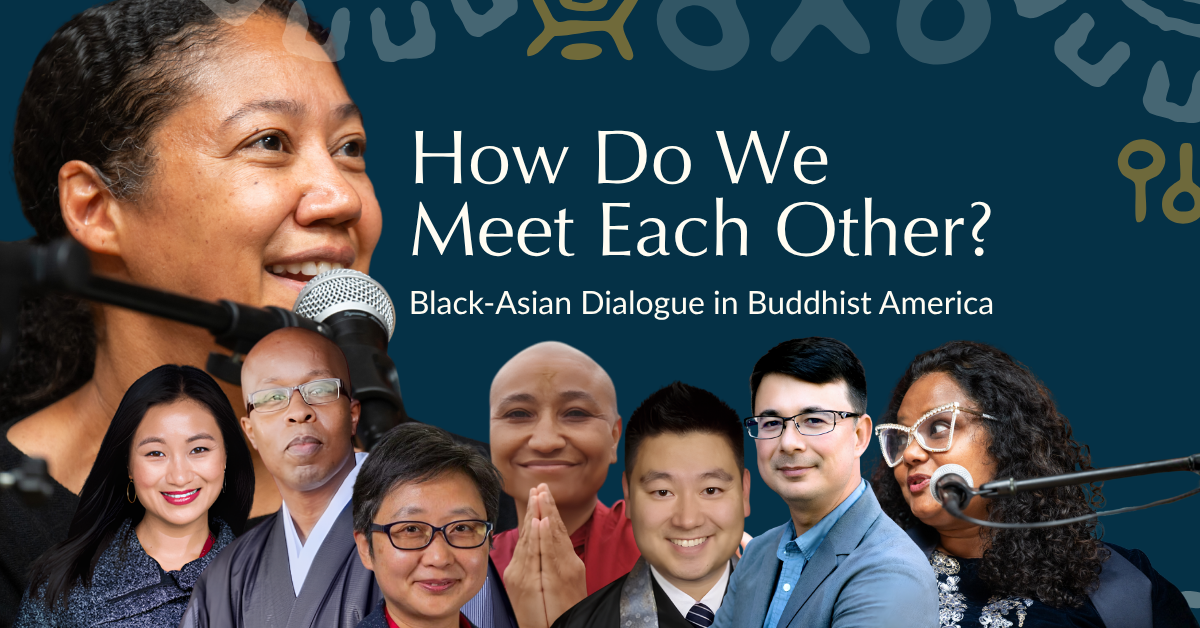
How Do We Meet Each Other?
A Series of Black-Asian Dialogues in Buddhist America
Touching the Earth with Thích Nhất Hạnh: A Conversation with Venerable Clear Grace Dayananda
Venerable Clear Grace Dayananda is the founder of Sangha House NOLA. She received novice ordination in 2018 as Sister True Moon of Clear Grace under Zen Master Thích Nhất Hạnh in the Plum Village Vietnamese Zen tradition, entering the Liễu Quán Dharma Line (8th generation) and the Lâm Tế Dhyāna (Linji) School (42nd generation). She later received higher ordination (upasampadān) in 2020 with the Embracing Simplicity Contemplative Order under her preceptors, the late Bhante U Pannadipa Thero and her recently transitioned master, Maha Theri Dr. Pannavati Karuna. Through this transmission she inherits a rich multi-lineage inheritance, Theravāda lineages from Sri Lanka, Nepal, and Burma, alongside Mahāyāna and Vajrayāna streams, including Vajrayāna empowerments, Sōtō Zen, and Vietnamese Zen. She was transmitted the Dharma name Dayananda, meaning One Whose Delight is Mercy.
This conversation series brings Black and Asian-American Buddhist scholars and practitioners together for honest dialogue about what it means to practice Buddhism in America today. These conversation partners aim to create bridges and ask nuanced questions — about ancestral practices and culture, about appropriation and erasure, and about what it means to evolve the Buddhist tradition to meet the current moment.
Each conversation is also a practice in itself: honoring the cultural roots each person brings, building real political solidarity, and growing a Buddhist community rooted in both care and accountability.
Hosted by Dr. Rima Vesely-Flad, IBS Research Fellow
Dr. Rima Vesely-Flad is a Research Fellow at the Institute of Buddhist Studies and the Founding Director of the Initiative for Black Buddhist Studies. She is the author of three books and several academic articles on Buddhism and Black culture, as well as religious approaches to systemic violence.
This series is generously funded by the Henry J. Luce Foundation.